
24 Team Bonding Activities in Singapore for Corporate Teams (2026)
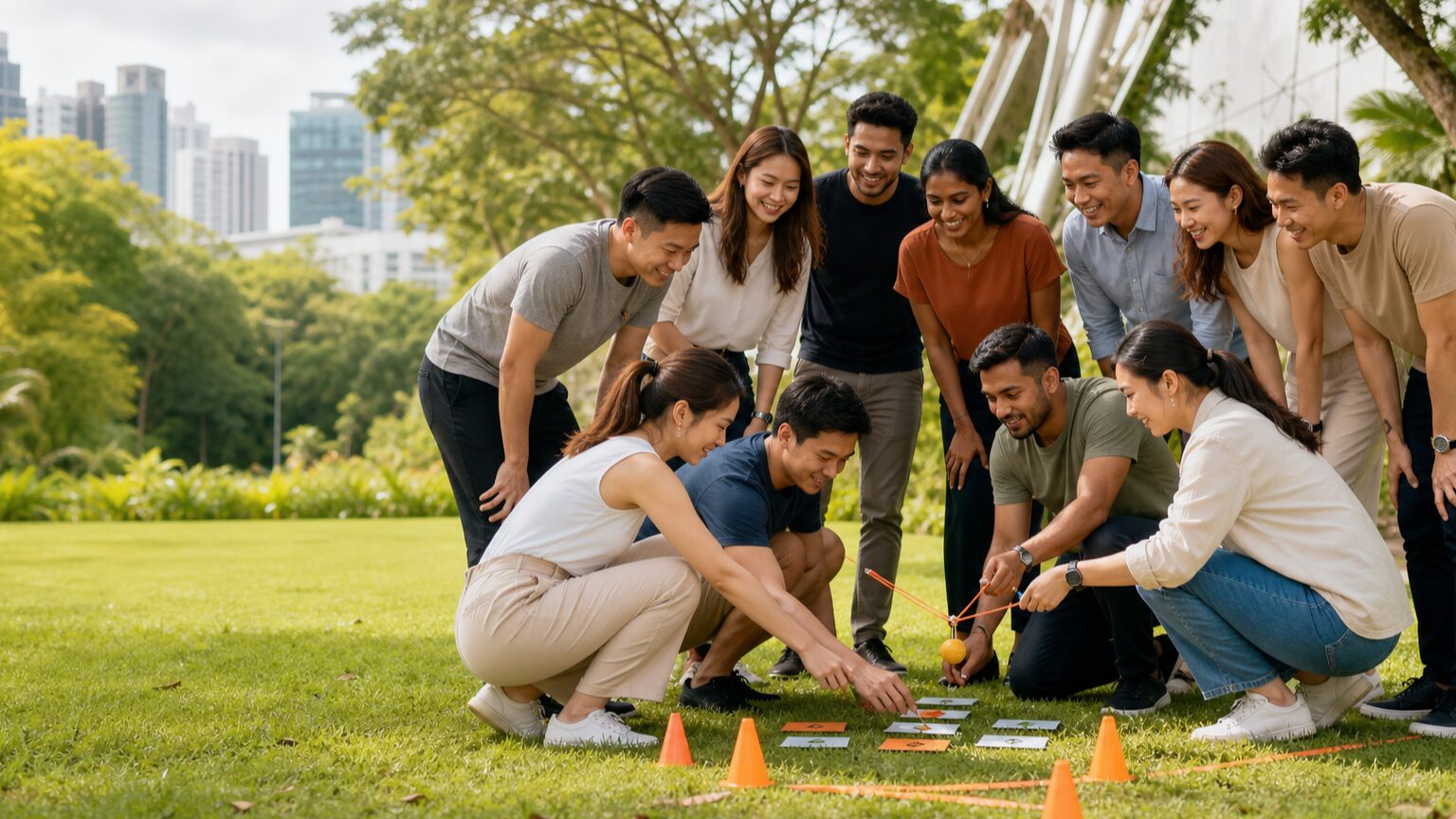
Budget doesn’t mean boring. Some of the best team building experiences in Singapore happen when you strip away the flashy venues and focus on what actually matters — people doing things together.
This guide covers practical team bonding activities in Singapore across DIY, venue-based and facilitated formats, without losing the laughter, connection or debrief moments that make team building worthwhile. Whether you’re an HR manager stretching a quarterly budget or a startup founder trying to keep morale high without burning cash, there’s something here for every team.
Use our event budget calculator to get a quick cost estimate before you commit.
Quick shortlist: team bonding activities by objective
Choose the format around the outcome, group size and operating constraints, not just the lowest advertised price.
- Morale and social connection: scavenger hunts, food trails, art jamming and office games.
- Communication and problem-solving: escape rooms, Amazing Race formats, raft building and cooking challenges.
- Inclusive participation: paper engineering, museum trails, pottery and structured workshops.
- Large groups: checkpoint races, park challenges and scalable team tournaments.
For a professionally facilitated programme, compare our team building activities in Singapore.
Choose the right group activity before comparing options
A long list is useful only after the team agrees on the decision criteria. Use this four-step filter to remove unsuitable activities before requesting availability or proposals.
- Define the workplace outcome: choose one primary goal such as social connection, cross-team communication, leadership practice or recovery after a demanding period.
- Set participation constraints: record headcount, accessibility needs, physical intensity, indoor or outdoor preference, travel time and the maximum time away from work.
- Choose the delivery model: use DIY bonding for an already healthy team and a simple social goal; use professional facilitation when the brief needs structured collaboration, observation or a debrief tied to work.
- Compare complete scope: check venue, equipment, facilitators, safety planning, wet-weather alternatives, transport and catering separately so proposals are evaluated on the same basis.
Fast rule: if the outcome can be achieved by colleagues spending enjoyable time together, start with a simple bonding format. If leaders expect a behavioural or team-effectiveness outcome, select a facilitated programme with a defined briefing and debrief.
Plan for everyone who will take part
Plan around actual participant needs rather than assuming that one format suits everyone. Check these points before you shortlist.
Physical comfort: a vigorous challenge that leaves some colleagues on the sidelines defeats the purpose. Ask for a lower-exertion or non-competitive role, and collect mobility, dietary and comfort needs privately rather than in front of the group.
Cultural fit: record alcohol-free preferences, dietary requirements and relevant certification needs. Confirm catering availability, activity adjustments and any additional charges in the quotation; do not assume they are included.
Seniority mix: avoid assigning exertion or confidence levels from job title or age. Offer ways to contribute and let participants raise access or comfort needs privately.
Location and weather: compare actual travel time, step-free access and on-site conditions. Name the forecast-check and stop-decision owner. An indoor or sheltered alternative requires advance confirmation and separate quotation unless expressly included.
Confirm scope and the weather decision before booking
This shortlist includes DIY and specialist examples; it does not establish that Get Out! supplies every activity listed. Get Out! does not offer sports events. Confirm the actual supported format, participant requirements, permissions, staffing and delivery scope in writing.
An early start, shade, an indoor label or a seasonal average does not establish that an activity is safe or suitable. Name the person who checks current forecasts and warnings, makes the delay, modification or stop decision, and contacts participants. Assess the actual route, ground conditions, heat, lightning, access and participant needs.
Wet-weather programmes, indoor or sheltered venues, venue hire, relocation, extra equipment and manpower are optional and separately quoted unless expressly included in the approved quotation. Alternatives depend on advance confirmation and availability. Without a confirmed safe alternative, an unsafe programme may need to be delayed, modified or stopped.
Use the outdoor planning guide for weather questions and the large-group guide for rotation and staffing checks. Confirm final scope with the team-building organiser.
Reading the examples: group sizes and durations below are illustrative planning ranges, not confirmed venue capacities, availability or quoted Get Out! packages. Validate them against the chosen activity, room, staffing and participants before booking.
Why Budget-Friendly Team Bonding Isn’t Second-Rate
There’s a persistent myth in corporate Singapore that the higher the per-head spend, the better the team building. It’s not true.
A premium venue does not guarantee connection, and a low-cost activity does not guarantee a useful outcome. Choose a format people can participate in, explain the purpose and allow a debrief that relates observations to work without diagnosing personalities.
Use shared tasks and informal conversation as programme design choices, not as a claim of proven psychological or business results. Ask what people noticed, whether anyone was excluded and what they would change next time.
Budget activities often force creativity — and creativity, as it turns out, is exactly what team building needs.
That said, cheap activities done poorly still waste money and time. The tips at the end of this guide will help you structure even a free activity so it lands properly.
Low-Setup Team Bonding Activities
1. HDB Heartland Scavenger Hunt
Group size: 10–60 | Duration: 2–3 hrs
Build a clue-based scavenger hunt across any HDB estate — Tiong Bahru, Toa Payoh, Queenstown — and you’ve got a surprisingly rich activity. Teams navigate by foot, solve riddles tied to local landmarks, and compete to finish first.
Use the neighbourhood as context without obstructing residents, photographing people without consent or assuming a void deck is bookable. Check route permissions, walking distance, crossings and rest points. Debrief with open questions rather than promising that the activity reveals leadership traits.
Compare this with other outdoor team building formats →
2. Reservoir Trail Challenge
Group size: 10–50 | Duration: 2–4 hrs
A reservoir-area observation or photography trail is a planning idea, not permission to use any route. Check current opening hours, access restrictions, route conditions, heat and lightning exposure before deciding whether a group visit is suitable. Avoid timed running challenges that pressure participants to ignore conditions.
A short debrief can invite observations about planning and communication. It does not establish a measured team-effectiveness result; Get Out! does not offer sports events.
3. Cooking Battle at a Community Centre
Group size: 8–30 | Duration: 2.5–3 hrs
A cooking challenge needs a venue that permits the proposed corporate use, suitable equipment and a confirmed instructor or responsible host. Ask the individual community facility about eligibility, availability, fees and food-handling requirements; public programme listings are not evidence of a bookable subsidised corporate session.
If a shared meal is part of the plan, confirm food allergies, dietary needs, handling arrangements and the meal scope before booking.
4. HDB Community Garden Build
Group size: 10–40 | Duration: 3 hrs
A community garden activity requires explicit permission and a useful brief from the responsible group. Do not assume a plot can be adopted for one day. Confirm supervision, tools, physical tasks and the ongoing care arrangement before volunteers arrive.
5. Escape Room (Budget Format)
Group size: 5–10 per room | Duration: 1–1.5 hrs
Singapore’s escape room scene has a full price spectrum. Availability and commercial terms vary by operator and date. Book multiple rooms and run a time-trial competition across groups. This works especially well for analytical teams — finance, tech, operations — where the puzzle-solving format mirrors real work dynamics.
6. Upcycling Workshop
Group size: Flexible | Duration: Set to fit your programme
An upcycling workshop can use recycled materials to make a small object or artwork. Confirm the room layout, ventilation, tools, manual-dexterity requirements and supported roles. Donation needs an actual receiving organisation and prior agreement; it is not an automatic outcome.
See our full guide to the upcycling workshop format.
7. Origami or Paper Engineering Workshop
Group size: 10–50 | Duration: 1.5–2 hrs
Paper towers or bridges offer a simple planning task. Confirm table space, materials, instructions and access needs rather than claiming universal inclusion or unlimited capacity. For larger groups, test the number of stations and facilitators before confirming a headcount.
8. Social Media Content Sprint
Group size: 8–40 | Duration: 2 hrs
Give teams a creative brief and time to produce a photo series or short video. Obtain location and participant permissions, offer a non-camera role and agree how files may be used. Existing phones do not make staff time, transport or publication rights free.
This works particularly well for marketing, comms, and creative teams — but cross-functional groups often surprise themselves.
9. Street Food Tour Challenge
Group size: 10–30 | Duration: 2–3 hrs
A hawker-centre observation or food-discovery route can be assessed for a group visit. Check operating hours, crowding, seating, allergies and dietary needs. Avoid eating-speed contests or requiring anyone to consume an unfamiliar dish; allow an equivalent non-food task.
Singapore’s hawker culture is deeply social and surprisingly rich in debrief material: how did your team make decisions with incomplete information? Who held the budget?
10. Museum Trail: Free Admission Venues
Group size: 10–40 | Duration: 2–3 hrs
For a museum trail, verify the current official opening, gallery access, group-booking conditions, admission eligibility and photography rules for the exact visit. Free entry may depend on visitor status, gallery or exhibition. Do not assume a named museum is open or that every colleague qualifies for free admission.
Facilitated and Venue-Based Activities
11. Amazing Race: Singapore Edition
Group size: 20–100 | Duration: 3–4 hrs
An Amazing Race-style team activity can combine route navigation and checkpoint tasks. Confirm access, headcount, checkpoint staffing, equipment and facilitation in the actual scope. No package inclusions or capacity follow from the example alone.
Planning a budget-conscious team day in the UAE instead? Compare low-setup team activity ideas for Dubai before setting scope.
12. Raft Building: Specialist Water-Based Example
Group size: 15–50 | Duration: 2–3 hrs
Raft building is a specialist water-based example, not a Get Out! service offer or a confirmed activity at Pasir Ris or East Coast. Any independent specialist would need to establish site permission, qualified supervision, participant suitability, rescue arrangements and weather stop rules. Do not improvise a water launch from this article.
13. Art Jamming
Group size: 10–50 | Duration: 2–3 hrs
For art jamming, ask the venue about materials, instructor scope, access, clean-up and what participants take home. A creative session can provide a shared experience but is not a treatment for conflict or a guaranteed route to psychological safety.
14. Laser Tag
Group size: 10–50 | Duration: 1.5–2 hrs
Laser tag is an energetic specialist example, not a statement that Get Out! supplies it. Confirm the actual activity rules, protective arrangements, exertion, access and participant suitability with the responsible specialist. Offer an appropriate alternative role and do not promise strategy-development results.
15. Virtual Reality Team Challenge
Group size: 6–30 | Duration: 2 hrs
VR arcades in Singapore now offer group packages with cooperative challenge modes. Teams problem-solve in immersive environments — escape scenarios, adventure games — and then switch, compare scores, and debrief. Good for tech-oriented teams and distributed teams that want something novel.
16. Cooking Masterclass (Hawker or Heritage Cuisine)
Group size: 10–30 | Duration: 2.5–3 hrs
A heritage-cooking session can use a shared recipe as its task. Confirm the instructor, food-handling arrangements, ingredients, dietary adaptations and commercial terms. Do not assume a community programme offers corporate group rates or that cooking changes workplace relationships.
17. Indoor Archery Challenge
Group size: 8–30 | Duration: 1.5–2 hrs
Archery is a specialist sporting example; Get Out! does not offer sports events. Do not organise a tournament from this guide. A responsible specialist would need to confirm the permitted site, competent supervision, equipment, exclusion zones and participant requirements.
18. Pottery Workshop
Group size: 8–25 | Duration: 2–3 hrs
For a pottery workshop, confirm instructor coverage, equipment, posture and hand-use requirements, firing or collection arrangements and the actual class limit. Offer alternatives where needed; the activity does not guarantee stress reduction or suitability for every participant.
19. Wine Appreciation Session
Group size: Flexible | Duration: Set to fit your programme
For a wine-appreciation session, confirm participant preference, age requirements, responsible serving, transport and a genuinely equivalent alcohol-free option before booking. Do not assume a venue can supply adaptations on request.
See our full guide to wine appreciation team building.
Free Team Bonding Ideas for Zero-Budget Teams
These five ideas can use existing resources, but staff time, materials, subscriptions, transport or venue access may still cost money. Check suitability and obtain any required permissions.
20. Two Truths and a Lie: Extended Format
Go beyond the party game version. Add rounds where teams must collaboratively decide which statement is the lie, present their reasoning, and discuss what the truths reveal. For teams that don’t know each other well, this generates more authentic connection than many paid activities.
21. Failure Forum
Invite volunteers to discuss a low-stakes work lesson and what they would do differently. Allow people to pass and do not require disclosure of sensitive incidents, clients or personal information. This exercise does not itself establish psychological safety.
22. 30-Day Team Reading Challenge
Choose a lawfully available shared article, book extract or podcast and schedule optional discussion. Check access and licence costs; a paid book or subscription is not a zero-cost resource. Make the material accessible and do not promise a workplace-performance result.
23. Photo Scavenger Hunt
Write a list of creative photo challenges — recreate a famous painting, find something older than the company, stage a team album cover — and send teams out with their phones over a lunch hour. Reveal every team’s shots at the end. Ridiculous fun, zero cost, entirely memorable.
24. Sunrise / Sunset Walk at a Nature Reserve
For a nature-reserve walk, check the exact route opening hours, lighting, permissions and current conditions before selecting a time. Sunrise or sunset is not evidence that a route is open or safe. Assess heat, lightning, access and participant needs and name the person who can modify or stop the visit.
Virtual, hybrid and creative formats to ask about
For teams split across Singapore and regional offices, a virtual or hybrid format keeps remote colleagues in the same experience.
Virtual Amazing Race: teams in different locations get the same digital puzzles, photo and video tasks, with a shared live leaderboard.
Online trivia or live game show: a hosted game show with categories built around your company and region.
Virtual cooking class: a live instructor leads everyone through the same recipe, with kits or a shopping list sent ahead.
Hybrid workshop: most of the team meets in Singapore while remote participants join a parallel track on shared challenges.
Digital escape room: small groups solve browser-based puzzles together from wherever they are.
Before booking, check time zones, devices and connection, how remote participants contribute, and what the organiser actually supports.
Creative examples include murder mystery, trivia, construction challenges, improv, drumming, terrarium or perfume workshops, mocktail activities and heritage trails. They are options to assess, not a claim that Get Out! delivers every format. Confirm capability, specialist involvement, scope and participant requirements in writing before booking.
Budget Planning Tips for HR Managers
Getting the most from a limited team building budget requires more planning upfront, not less.
1. Know your real cost drivers
For most team building events, the biggest cost variable isn’t the activity — it’s logistics. Transport, catering, and lost work time add up fast. Build these into your budget calculation from the start.
Use the event budget calculator to model total costs before requesting budget approval.
2. Off-peak is your best friend
Weekday slots are often easier to secure and can be more flexible on pricing than Friday afternoons or weekends for facilitated activities. If your team’s schedule allows it, ask about off-peak options when you request a quote.
3. Consolidate groups
Running one combined activity instead of several smaller ones can help keep the cost per head down. Consolidation also creates more cross-functional mixing, which is usually the actual goal.
4. Book early
Popular periods such as the year-end season can fill up early. Checking availability as soon as your date and headcount are clear gives you better slot selection.
5. Keep catering simple
A hawker meal after a team activity often generates more conversation than a sit-down catered lunch. It is simpler to arrange and can feel more authentic.
6. Use our cost comparison tool to benchmark options side by side.
How to Negotiate Group Rates
Singapore’s team building market is competitive, which gives HR managers leverage — if they know how to use it.
Lead with commitment, not price
Don’t open with “what’s your cheapest option?” Open with your group size, date, and duration. Operators are negotiating on margin, and a confirmed weekday booking is usually worth more to them than a tentative weekend enquiry.
Ask about package customisation
Many operators have modular pricing. If you don’t need the premium catering or the full facilitated debrief, ask what a stripped-down package looks like. A simpler package may fit your budget better than the full programme.
Bundle across quarters
If you’re planning quarterly team building, offer to commit to two or three bookings upfront. Some operators may offer better terms for confirmed repeat bookings, so it is worth asking.
Request last-minute fills
Some operators may offer better terms to fill slots close to the date. If your team can plan on short notice, it is worth asking about available slots.
Get quotes from multiple operators using the cost comparison tool before negotiating. Knowing the market rate removes most of the information asymmetry.
Run the day so the bonding lasts
Build an arc: warm up, then the main activity, then a debrief or celebration. Do not start with the hardest activity and leave the food for last.
Keep the debrief: a short facilitated reflection or an informal chat after the activity is where people talk about what they noticed about each other and what they would do differently.
Check in afterwards: a simple before and after pulse question, such as “How connected do you feel to your team?” on a simple rating scale, tracked over time, shows whether the approach is working. Treat it as feedback, not proof of a performance result.
Frequently Asked Questions
When should a team-building activity use a facilitator?
Use a facilitator when the objective goes beyond informal bonding, especially for communication, trust, leadership alignment or collaboration after change. DIY activities can work well for healthy teams, but structured briefing and debriefing make the learning more deliberate.
What’s the best cheap team building activity for large groups?
For 50 or more participants, compare checkpoint-based formats with a station or seated activity. Confirm route access, station throughput, staffing, equipment, briefing and weather decisions for the actual headcount. An example group-size label is not certified capacity, and outdoor use is not automatically free.
Can we do team building in Singapore without a facilitator?
Yes — especially for activities like museum trails, cooking, scavenger hunts, and most outdoor challenges. Self-facilitated activities work best for teams that already have decent psychological safety. If your team has unresolved tension or low cohesion, a facilitator adds significant value even for a simple activity.
How many hours should a budget team building session run?
Two to three hours is the sweet spot for most teams. Long enough to build momentum and produce a genuine shared experience; short enough that people don’t lose energy or start thinking about deliverables. Half-day sessions (3–4 hours) work for teams going through significant change or coming off a tough quarter.
Are community centres good for corporate team building?
A community facility may be an option if its actual room, booking eligibility, permitted use and equipment meet the brief. Check availability, fees, access and programme rules directly with the facility. Do not assume every community centre accepts corporate bookings or supplies materials and facilitation.
What’s the difference between team bonding and team building?
Team bonding is informal: people spend time together and enjoy it. Team building is structured: the activity is designed to surface and address specific team dynamics. Both have value. If you’re trying to fix something — communication breakdowns, siloed teams, new managers — you need team building, not just bonding. If you’re maintaining a team that’s already healthy, bonding is often enough.
How do I get budget approval for team building?
Frame the request around the business objective, expected participation, programme format, operational requirements and how the team will apply the outcome afterwards. Approvers need a clear scope and rationale, not an unsupported per-person estimate.
Are there team bonding activities for remote or hybrid teams?
Yes. Virtual trivia, digital puzzles, online cooking and hybrid parallel challenges are options to assess. Check time zones, devices, kit delivery and how remote participants contribute, then confirm the supported format before booking.
Can a team bonding activity be customised to our company theme or values?
Ask which parts of the programme can be customised, who supplies brand or company content, and what preparation is needed. Some venue-based formats have fixed rules. Confirm the final brief and approval deadline in writing.
How far in advance should we book a team bonding event?
Check organiser and venue availability as soon as your date, expected headcount and format are clear. Ask about quotation validity, booking deadlines and change terms. No fixed lead time guarantees a slot.
Ready to Plan Your Activity?
The most important variable in any team-building activity is preparation. Clear objectives, a tight brief and even a short facilitated debrief can transform an average activity into a memorable one.
Start with the event budget calculator to model your total costs. Compare options across format and group size using the cost comparison tool. And when you’re ready to book, explore our full team building Singapore listings to find the right fit.
Good team building doesn’t have to be expensive. It just has to be intentional.
When Cheap Team Bonding Is Not Enough
Budget-friendly team bonding is useful when the goal is morale, participation and a light shared experience. But if the brief is about leadership alignment, psychological safety, team effectiveness or collaboration after a change, the format needs more structure than a list of low-cost activities.
For HR and L&D teams, Get Out! Events can convert the activity format into a leadership team-building workshop in Singapore with facilitated debriefs, practical workplace reflection and clearer outcomes for managers.
- Choose cheap team bonding when morale and participation are the main goals.
- Choose leadership team building when communication, trust and alignment matter more.
- Choose a half-day facilitated workshop when the team needs both energy and serious takeaways.
Leadership or informal bonding: two planning questions
When should a company choose leadership team building instead of cheap team bonding?
Choose leadership team building when the objective is communication, trust, psychological safety, manager alignment or team effectiveness. Choose cheap team bonding when the main goal is simple morale and participation.
Can a low-cost activity be adapted for a serious leadership outcome?
Sometimes. The activity can be simple, but the briefing, facilitation, debrief and action planning need to be designed around the leadership outcome.
Plan Your Team Bonding Event
Tell us your team size, objectives, preferred date and format. Get Out! Events will shape the right programme around your brief.
Thousands of events delivered since 2012.